
The 2026 SME financing gap
The disconnect between viable small businesses and available capital has widened. Traditional banks continue to reject sound SME credit applications, not because the businesses are inherently risky, but because legacy scoring models cannot accurately measure that risk. This structural failure creates a significant financing gap that AI-driven alternatives are now positioned to fill.
The OECD’s 2026 Scoreboard confirms that debt financing remains the primary lifeline for SMEs across 48 countries. Despite this reliance, rigid underwriting criteria based on historical financial statements exclude many growing enterprises. Lenders often lack the data infrastructure to assess real-time cash flow or alternative credit signals, leading to blanket rejections for otherwise healthy companies.
This is not a problem of risk, but of measurement. As noted by industry analysts, most SMEs in emerging markets are not rejected for being risky; they are rejected because lenders cannot measure their risk accurately. The traditional binary of "approved" or "denied" fails to capture the nuance of modern SME operations, leaving a vast market underserved.
The result is a lending landscape where capital sits idle while viable businesses struggle to grow. This gap represents both a market failure and an opportunity for new entrants who can deploy machine learning to process unstructured data and provide more accurate, inclusive credit decisions.
How AI changes risk assessment
Legacy credit scoring treats small and medium-sized enterprises like personal consumers, relying on FICO scores and static balance sheets that often don’t exist for younger firms. This approach creates a blind spot: it assumes a lack of traditional data equals high risk. In reality, many SMEs in emerging markets are rejected not because they are risky, but because lenders cannot measure their actual financial health using outdated metrics. As noted by industry analysis, the barrier is often measurement capability, not borrower quality.
AI models solve this by ingesting alternative data streams that reflect real-time business activity. Instead of waiting for quarterly audits, lenders can analyze cash flow patterns, digital footprints, and transaction histories. These models use gradient boosting algorithms to find non-linear correlations between daily operational data and creditworthiness. This shifts the focus from historical collateral to forward-looking predictive power, allowing for more accurate risk pricing.
The result is a more granular view of risk. By incorporating variables like payment consistency with suppliers or digital revenue trends, AI reduces the noise that plagues traditional scoring. This enables lenders to extend credit to viable businesses that were previously invisible, effectively turning unmeasurable risk into manageable, data-driven decisions.
Building the AI credit profile
Traditional credit scoring relies heavily on historical financial statements, a lagging indicator that often fails to capture the real-time health of small and medium enterprises. AI-driven models require a continuous stream of structured data to assess risk accurately. If the input data is fragmented or outdated, the algorithm cannot generate a reliable probability of default, leaving the lender exposed to hidden liabilities.
Preparing your data for an AI scoring engine is not merely an IT task; it is a fundamental risk management exercise. The goal is to transform disparate operational records into a coherent digital footprint that mirrors the business’s actual performance. Accuracy here determines whether a viable borrower gets capital or gets rejected by a flawed model.

Start by standardizing your last three years of audited financial statements. AI models require consistency in how revenue, expenses, and liabilities are categorized. Inconsistent accounting practices across different quarters introduce noise that degrades model precision. Ensure all invoices are matched to ledgers and that cash flow statements reflect actual liquidity positions rather than accrual estimates.
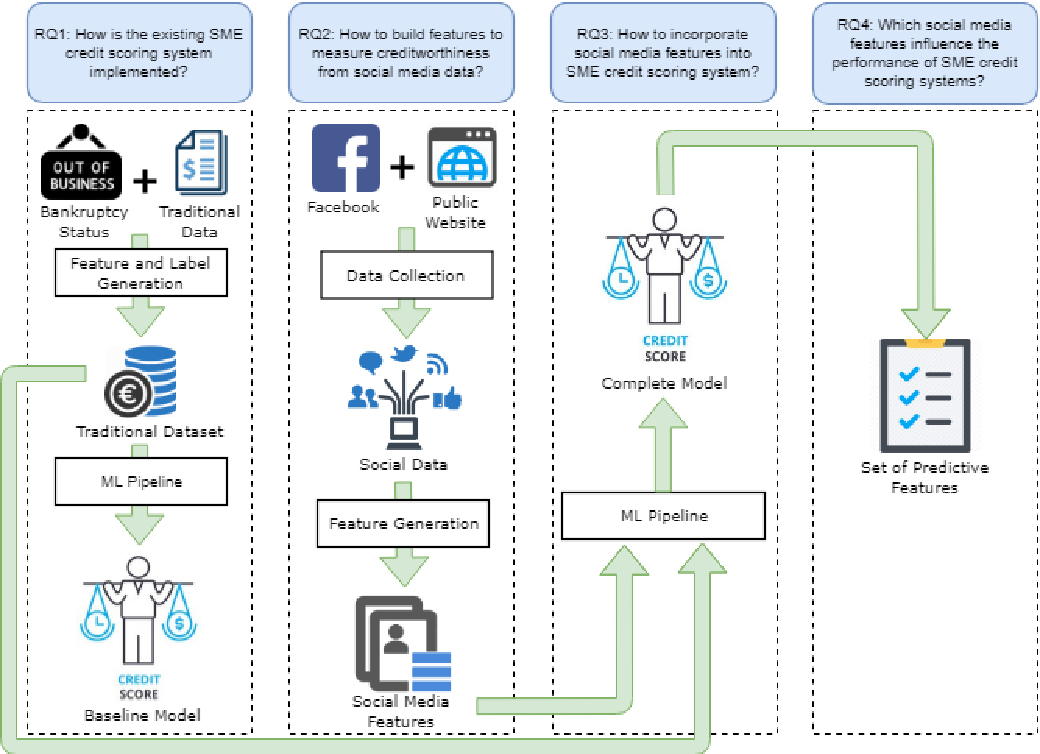
Traditional credit bureaus often lack sufficient data for SMEs, especially newer ones. You must connect operational data sources such as point-of-sale systems, inventory management software, and utility payment histories. These alternative data points provide a real-time view of business activity. Lenders use this information to verify revenue stability and detect early signs of distress before they appear on a balance sheet.
Map out your top twenty customers and suppliers. AI models analyze concentration risk by examining the stability of your supply chain and revenue base. If a significant portion of your income comes from a single client, the model will flag this as a vulnerability. Provide data on payment terms, contract durations, and historical payment behavior to demonstrate resilience against market shocks.
SME credit is inextricably linked to the principals behind the business. Compile verified identification documents, educational backgrounds, and professional histories of the owner and key executives. Some AI systems also analyze digital footprints, such as public professional profiles or news mentions, to assess reputation risk. Any discrepancies here can trigger immediate manual review or rejection.
Before sharing data, ensure you have explicit consent mechanisms in place for data sharing. Regulations like GDPR and local data protection laws require clear authorization for third-party access. Implement secure API connections or encrypted data rooms to transmit information. Lenders prioritize applicants who demonstrate rigorous data governance, as it reduces the legal and operational risk of the lending process.
A well-prepared data profile does more than just secure approval; it positions the SME for better terms. When an AI engine can clearly see a stable, transparent, and low-risk operation, it assigns a more favorable risk score. This translates directly to lower interest rates and higher credit limits. The effort to structure this data upfront pays dividends throughout the lifecycle of the loan.
| Data Category | Traditional Model | AI Scoring Model |
|---|---|---|
| Financial Statements | Annual or quarterly snapshots | Real-time transaction feeds |
| Credit History | Public filings and bureau reports | Alternative data and cash flow patterns |
| Risk Assessment | Static thresholds and rules | Dynamic, behavior-based probability |
From score to stablecoin credit
An AI-driven credit score is only as valuable as the capital it unlocks. For SMEs, the transition from a static risk assessment to a dynamic, RWA-backed stablecoin line of credit represents a fundamental shift in lending mechanics. This model replaces legacy underwriting latency with real-time liquidity, allowing businesses to access funds against verified digital assets rather than waiting weeks for bank approvals.
The core advantage lies in the reduction of friction. Traditional SME lending relies on historical financial statements that may be months old, creating a lag between a business's current performance and its borrowing capacity. In contrast, stablecoin credit lines utilize on-chain data and AI scoring to assess creditworthiness continuously. This allows for instant disbursement and repayment, aligning capital availability with actual cash flow cycles. The result is a lending environment where risk is managed through transparent, real-time data rather than retrospective paperwork.
To understand the practical impact, consider the structural differences between traditional bank loans and AI-driven stablecoin credit lines. The table below contrasts key operational metrics, highlighting the speed and collateral efficiency of the new model.
| Feature | Traditional Bank Loan | AI-Driven Stablecoin Line |
|---|---|---|
| Approval Time | 2–6 weeks | Minutes |
| Collateral Type | Physical assets, P&L | RWA-backed digital assets |
| Interest Rate | Fixed, higher spread | Dynamic, market-based |
| Data Source | Quarterly statements | Real-time on-chain + AI |
| Access Frequency | One-time draw | Revolving, instant |
This comparison underscores the efficiency gains inherent in the new lending playbook. By leveraging AI for risk assessment and stablecoins for settlement, lenders can offer lower spreads and faster access to capital. For SMEs, this means working capital is no longer a bottleneck but a flexible tool for growth. The integration of these technologies creates a more resilient lending ecosystem, where data accuracy directly translates to financial stability.
Common scoring mistakes to avoid
AI-driven credit models are only as reliable as the data they ingest. When SME credit scoring relies on messy, inconsistent inputs, the resulting risk assessments become dangerously inaccurate. This section outlines the most frequent data hygiene failures that undermine lending accuracy.
Ignoring data normalization
Businesses report financials in different formats—some use accrual accounting, others cash basis. Without normalizing these figures into a standard framework, models misinterpret revenue stability. A clean, unified data structure is essential for consistent scoring across diverse SME profiles.
Overlooking non-financial signals
Traditional models focus heavily on balance sheets, ignoring operational data like supply chain resilience or customer retention rates. Modern scoring requires integrating these qualitative signals. Excluding them creates blind spots in risk assessment, particularly for newer firms with limited financial history.
Failing to update data in real time
Static data snapshots become obsolete quickly. SMEs can experience significant cash flow shifts within weeks. Models that do not refresh data regularly produce stale risk scores, leading to either excessive caution or dangerous over-lending. Real-time data integration is critical for current accuracy.
Business credit score ranges explained
Business credit scores operate on a different scale than personal FICO scores, a distinction that directly impacts lending risk models. While personal credit typically ranges from 300 to 850, business credit scores usually fall between 0 and 100. This narrower range reflects the specific financial reliability of the entity rather than individual credit history.
The higher the score, the more financially stable the business appears to lenders. A score near 100 signals low risk, facilitating access to capital, while scores closer to 0 indicate high default probability. Understanding this numeric boundary is essential for accurate SME credit risk assessment in 2026.
No comments yet. Be the first to share your thoughts!